Research intelligence for anyone who can't afford to be wrong
One AI can confidently make things up. MelMat runs four side by side and shows you exactly where they disagree — because that's where the risk hides.
98.6% of MelMat briefs land in our lowest hallucination-risk tier.
Most AI tools can't say that!
Free for 7 days. No charges. Cancel anytime.
Not ready? See an example brief first
🔒 We never train AI on your chats.
Consultants · Executives · Investors & Analysts · Legal & Compliance · Clinicians · Researchers
"MelMat cuts through the noise and gives you the confidence that comes with true due diligence."
Most people use one AI tool and take whatever it says at face value. That works for simple questions. For anything with real stakes — strategy, market research, competitive analysis — one model isn't enough.
Every AI has different training data and blind spots. One answer is one opinion — not the full picture.
Running the same question through multiple AI tools manually wastes 30–45 minutes per query.
Even if you run multiple models, you still have to reconcile different answers yourself. That's the hardest part.
Type your research question into the portal and select a focus — Strategic, Technical, Market, Clinical Research, or more. That's it.
Your selected engines receive your question simultaneously. Perplexity grounds every response in live web sources — the others bring deep analytical reasoning.
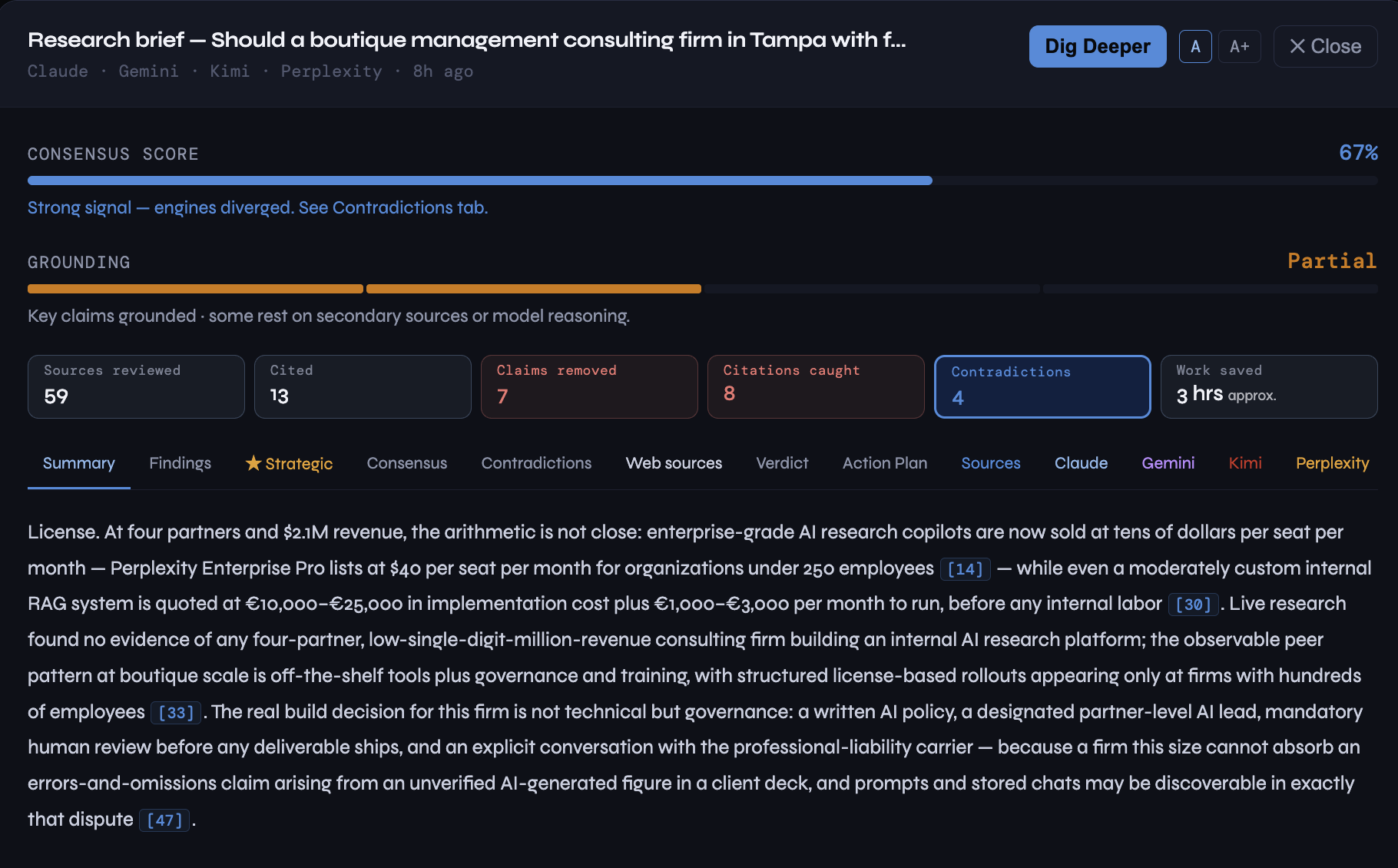
A synthesis pass reconciles all responses into one professional brief — highlighting consensus, flagging contradictions, and delivering a clear action plan.
Pro+ users can customize which AI engines power their research. Pick 3 from your available pool — Perplexity is always included for live web context.
Starter: Fixed stack (Claude + ChatGPT + Gemini + Perplexity)
Pro: Pick 3 from 5 engines (+ Mistral, MiniMax) + Perplexity
Power: Pick 3 from 6 engines (+ Kimi) + Perplexity
Researcher: Pick 3 from 7 engines (+ Grok exclusive) + Perplexity
Other tools force you to choose: chat mode or research mode. MelMat gives you both — plus consensus, contradictions, and an action plan you can defend in front of a client, board, or partner. One workspace. One source of truth.
We don't claim to eliminate them. We verify and sift through them, as the numbers below portray. Every brief is independently evaluated by 4 verifiers — and the results are tracked, graded, and published.
25+ years in financial services, most recently VP of Mortgage Compliance at Wells Fargo — work where an unverified answer isn't an inconvenience, it's a finding. Inside a big firm, someone always checks your work before it goes out. On your own, that layer doesn't exist.
MelMat is that checking layer, rebuilt — four engines, live sources, and every disagreement surfaced instead of smoothed over.
I built MelMat myself, end to end: the four-engine pipeline, the grounding layer against primary sources, the verification and grading stack, the portal. It’s patent-pending, and it’s held to the standard I worked under for 25 years, where “probably right” isn’t a finding.
Member, Embarc Collective · Tampa
"If you care about using AI responsibly and are looking for deep, verified insights without chasing various sources for hours, MelMat does the work for you — it cuts through the noise and gives you the confidence that comes with true due diligence."
"The contradictions section saved me — three of the four models said one thing, Perplexity pulled live data that contradicted them. I was about to put the wrong number in a deck."
"It's slower than ChatGPT but I can actually defend what comes out of it. I don't read the whole brief — I read the consensus score, the contradictions, and the verdict."
"The methodology page at the bottom is what got me to pay. I needed something I could point to when a partner asked 'how did you arrive at this.'"
"Dig Deeper is what I didn't know I needed. The brief gives me the answer; Dig Deeper lets me poke at the parts that don't sit right."
"Being able to see where different AI models agree and diverge on viewpoints is very helpful and cuts down on time required to verify outputs. I also really, really love the action plan. Succinct, specific, and actionable!"
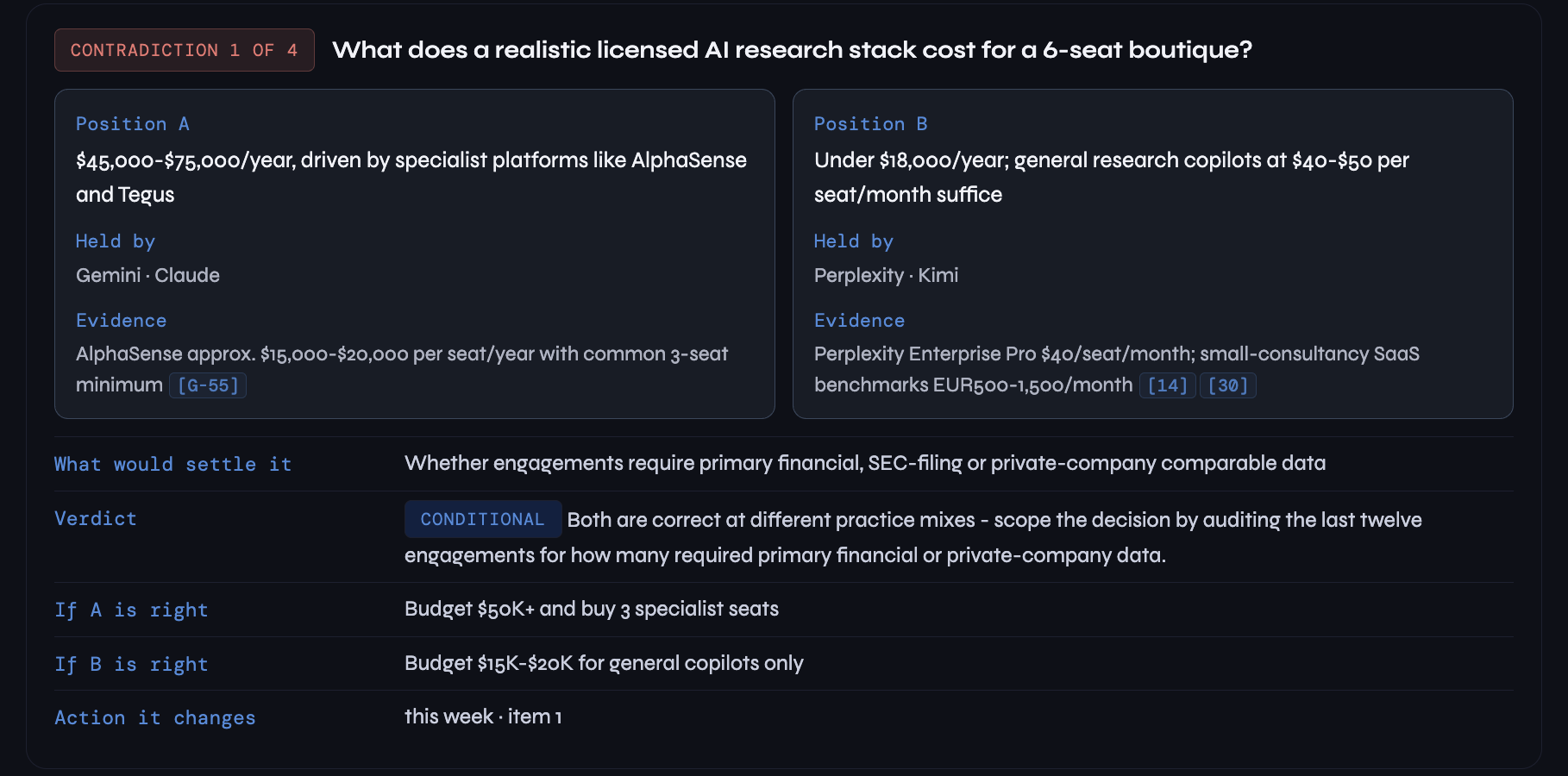
Actual MelMat briefs across legal, financial, technical, clinical, and strategic questions — four engines on every one, with the contradictions surfaced rather than smoothed over. One full brief is shown in its entirety below; the rest are previews.
The SBA 7(a) maximum loan amount remains $5,000,000, with maximum SBA guaranteed exposure of $3,750,000 on standard loans [3], and guarantee percentages holding at 85% for loans of $150,000 or less and 75% for loans above that threshold under 13 C.F.R. §120.202 [5]. The material change for 2025–2026 is not pricing or size — it is eligibility gatekeeping: the SOP 50 10 revision effective June 1, 2025 reinstated the SBA Franchise Directory as the controlling eligibility mechanism, requiring any brand meeting the FTC definition of a franchise to be listed before a franchisee can be financed [13]. Layered on top are restored underwriting discipline — a reinstated 10% minimum equity injection for startups and changes of ownership [25], mandatory independent Quality of Earnings reports for acquisitions at $3 million or greater beginning October 1, 2026 [32], and an explicit anti-passive test requiring the borrower to control budgeting, staffing, and bank accounts [13]. If you are underwriting or applying for a franchise deal without first confirming the brand's live Directory listing and current franchisor certification status, you are exposed to a post-close guarantee denial on a loan you cannot unwind — the eligibility defect is not curable at repair.
All four analyses agree:
| What would settle it | Live SBA Franchise Directory listing status for the specific brand |
| Verdict | Resolved: B Resolved — the Directory is reinstated and is the binding test. |
| If A is right | Lender performs brand-level affiliation analysis on every franchise credit |
| If B is right | Lender checks Directory listing and franchisor certification status at application and again at closing |
| Action it changes | This week · item 1 |
| What would settle it | The brand's current listing and certification status in the live SBA Franchise Directory |
| Verdict | Conditional The extension is the later-dated web finding, but both deadlines have passed — confirm per-brand listing status in the live Directory before quoting terms. |
| If A is right | Deals in pipeline before Aug 2025 may have closed under the addendum procedure |
| If B is right | Brands had through mid-2026 to certify; non-certified brands are now off-Directory |
| Action it changes | This week · item 1 |
| What would settle it | Current SOP 50 10 text on equity injection minimums and DSCR floors |
| Verdict | Conditional On equity injection, resolved — the 10% floor is restored. On specific DSCR numerics, unresolved — verify directly in the current SOP text. |
| If A is right | Deals can be structured with lender-determined injection below 10% |
| If B is right | Every startup and change-of-ownership deal needs a documented 10% injection at minimum |
| Action it changes | This week · item 2 |
| What would settle it | Brand maturity and current Directory listing status |
| Verdict | Both, by scope Both are correct at different scales — faster for listed established brands, a hard constraint for emerging concepts and quasi-passive structures. |
| If A is right | Budget longer cycle times and added legal review cost per franchise file |
| If B is right | Standardize intake around a Directory check and reallocate legal spend to control analysis |
| Action it changes | This month · item 1 |
The 7(a) program remains a well-priced risk on its face — $5,000,000 of capacity at a 75% guarantee above $150,000 [5] is unchanged and is not the variable that will determine outcomes in this cycle. The variable is eligibility documentation integrity, and specifically live Franchise Directory listing plus franchisor certification status at the moment of closing. Kimi's framing — that the Directory was retired and franchise eligibility now runs through lender-side affiliation analysis — is contradicted by both web-grounded voices, and any credit policy still operating on that assumption should be rewritten this week. Claude and Gemini correctly read the direction of travel toward restored discipline; Gemini's live-search detail on the reinstated 10% equity injection [25] and the $3 million Quality of Earnings trigger [32] is the operative underwriting picture, though the specific DSCR floor could not be independently confirmed and should be read out of the SOP text directly.
For a lender: this is a risk worth taking, conditional on a mandatory Directory-and-certification verification gate at both application and closing — without that gate, franchise 7(a) is a 100%-loss-exposure product wearing a 25%-loss-exposure label. For a franchise borrower: proceed if your brand is listed and you genuinely operate the business; if you are a master franchisee, a passive investor behind a management company, or a quasi-passive space-licensor concept, the program is closed to you and no amount of credit strength reopens it [13]. The verdict flips to negative only if the target brand's certification lapses or QofE-validated earnings fail to support a servicing DSCR — at which point the correct action is to kill the deal rather than restructure around the guarantee.
For lenders and franchise sponsors, the 2025–2026 SOP cycle does not change the economics of the 7(a) guarantee — $5,000,000 maximum, $3,750,000 maximum guaranteed exposure, 75% guarantee above $150,000 [3][5] — but it materially changes the probability that the guarantee is honored. The primary driver of value and risk is no longer credit quality alone; it is eligibility documentation integrity. A franchise loan booked on a brand that is not listed, not certified, or structured so the borrower is a passive investor is a loan whose guarantee can be denied at purchase, converting a 25%-loss-exposure asset into a 100%-loss-exposure asset.
The optimistic scenario requires: the target brand is listed on the Directory with an executed Franchisor Certification; the borrower directly operates units rather than collecting sub-franchise royalties [13]; the borrower controls budgeting, employees and bank accounts with no management agreement that strips oversight [13]; a 10% equity injection is documented and sourced [25]; and all owners and guarantors satisfy the tightened citizenship standard [34]. Where those hold, centralized Directory review is genuinely faster than brand-by-brand legal review, and the reported $10 million combined 7(a)+504 capacity [24] materially expands financeable deal size for multi-unit developers. Fee relief remains a tailwind in targeted categories, with guarantee fees waived on certain FY 2026 manufacturer loans up to $950,000 [9].
Guarantee denial on eligibility defect. Directory inclusion is not permanent [13]; a brand listed at application may be off-Directory at closing, and the lender's unguaranteed exposure jumps from 25% to 100% of principal on a loan up to $5,000,000.
Passive-structure reclassification. Managed models, master franchise arrangements and quasi-passive concepts are explicitly ineligible [12][13]; deals structured pre-June 2025 may not be refinanceable or expandable under current rules.
Acquisition cost and timeline inflation at the $3M threshold. The QofE mandate [32] plus removal of acquisitions from the Small Loan path [25] adds third-party cost and weeks of diligence; deals priced on adjusted EBITDA will fail to service debt on validated numbers — expect re-trades or dead deals, not just delays.
Capital structure disqualification. The reported 100% U.S. citizen/national standard [34] can render a franchisee ineligible on cap table composition alone.
34 sources reviewed · 17 cited · grounding Corroborated (13 CFR Part 120 verified in eCFR; two live-web voices independently confirm the load-bearing figures). Cited references:
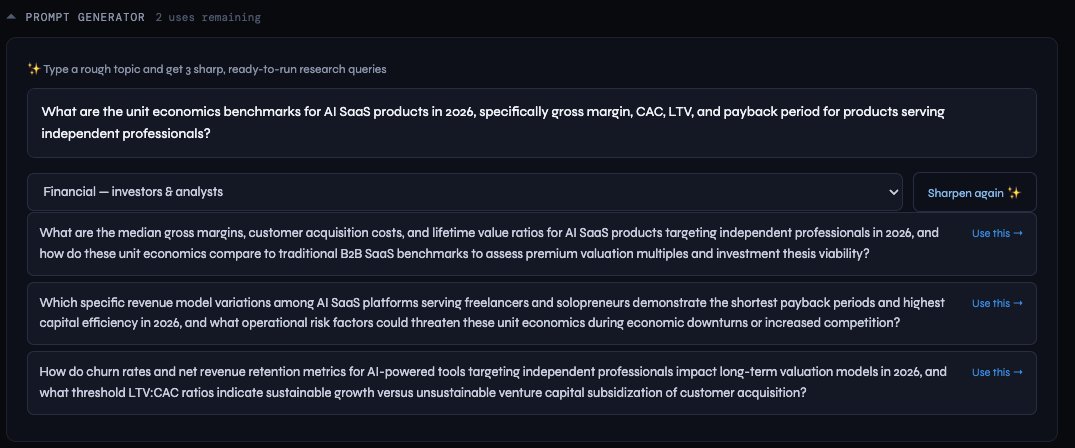
The quality of your research depends on the quality of your question. MelMat includes a built-in Prompt Generator that turns a rough topic into a sharp, focused research question, so you get better answers every time.